What a Good Job Search System Actually Looks Like
Most job seekers know they need a system, but few know what that actually means. A good job search system connects applications, conversations, and follow-ups into one clear process.
By this point, most job seekers realise something is not working.
Applications feel scattered.
Conversations are hard to track.
Follow-ups are inconsistent.
The issue is not effort.
It is the lack of a system.
If you missed the previous article, read
Job Searching Without a System Is a Mistake.
What most people think a system is
When people hear “job search system”, they often think of a spreadsheet.
A list of:
- companies
- roles
- dates
This can help at the beginning.
But as soon as the search becomes active, it starts to break down.
Why a list is not enough
A job search is not just a list of applications.
It involves:
- ongoing conversations
- multiple stages
- follow-ups
- decisions
A list cannot connect these things together.
That is why problems start appearing:
- conversations get lost
- follow-ups are missed
- context disappears
If this sounds familiar, you may want to revisit
Losing Recruiter Conversations Is a Job Search Mistake.
What a real system includes
A good job search system connects everything in one place.
At a minimum, it should give you visibility across:
1. Applications
Every role you have applied for, clearly tracked.
2. Stages
Where each application currently sits:
- applied
- screening
- interview
- offer
3. Conversations
Emails, recruiter messages, and updates linked to each role.
4. Follow-ups
Clear reminders for when to reach out and what needs action.
If follow-ups are inconsistent, revisit
Not Following Up Is a Job Search Mistake.
The shift from list to pipeline
The biggest change is moving from a list to a pipeline.
A pipeline shows:
- where everything is
- what is moving forward
- what needs attention
Instead of guessing, you can see your entire job search at a glance.
What this changes
When your job search is structured as a system:
- nothing gets lost
- follow-ups become consistent
- decisions become clearer
You stop reacting to what happens.
You start managing the process.
Bringing everything together
A good job search system does not add more work.
It removes friction.
It connects applications, conversations, and follow-ups into one clear view.
That is what allows momentum to build.
If you want a practical way to start structuring your search, see the
job application tracker guide.
If you are still earlier in the process, you may want to revisit:
Five parts of a complete job search system
- Opportunity list: roles and companies worth considering, including saved roles not yet applied to.
- Application pipeline: a consistent stage for every active application.
- Communication history: recruiter names, messages, interview details, and decisions attached to the right role.
- Next actions: follow-ups, preparation, and decisions with dates.
- Review loop: a weekly check of results so the strategy improves over time.
A system is only useful if it answers three questions quickly: Where does each application stand? What requires attention next? What is the search teaching you?
Test your current setup
Choose any active application and see whether you can find the job description, résumé used, latest message, stage, and next action in under a minute. If not, information is still too fragmented.
Start with the fields in the job application tracker template. If a spreadsheet no longer connects the information you need, compare the warning signs in when a job application spreadsheet stops working.
A system should surface the next action
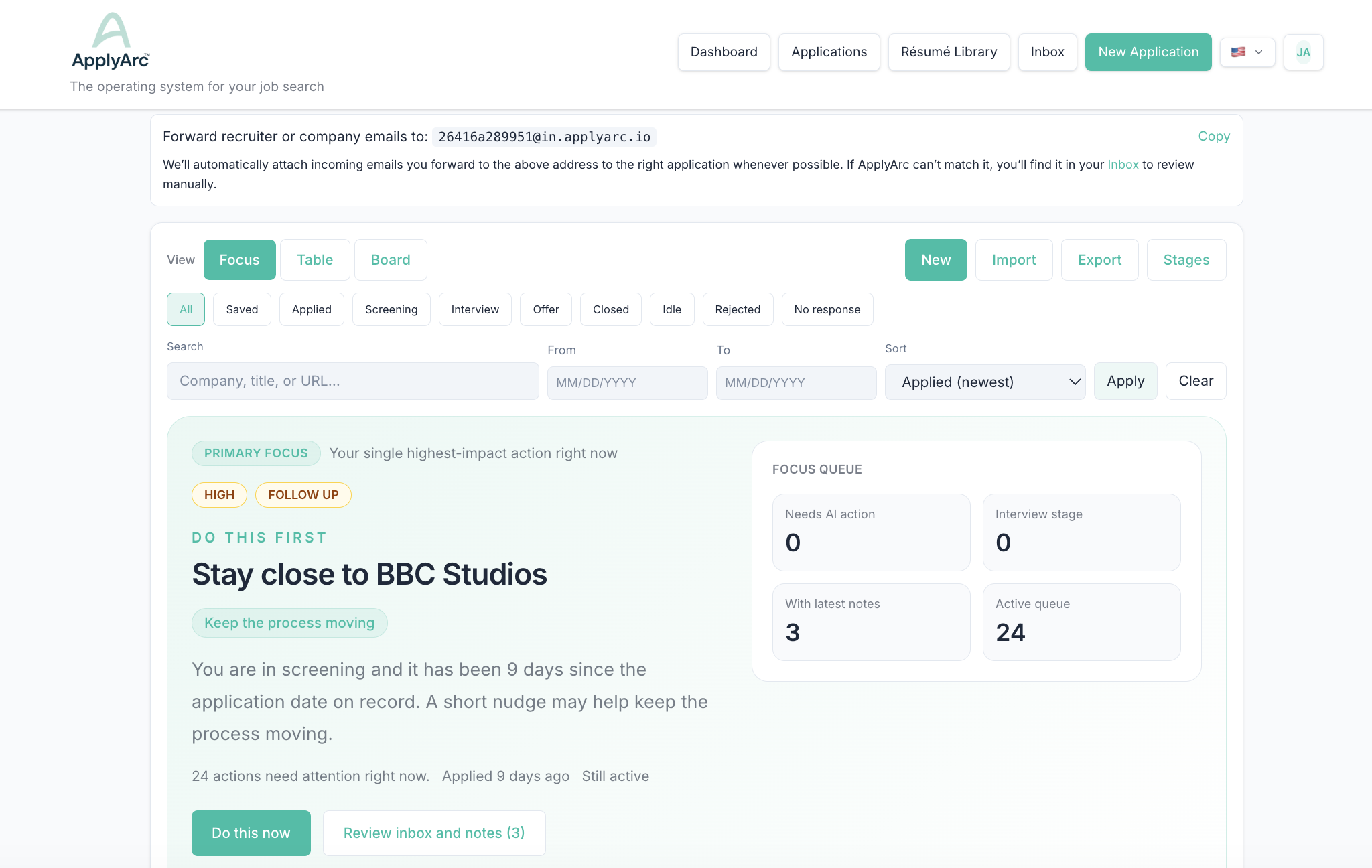
The system should reduce decisions by showing what needs attention now. Select the screenshot to open the full-size view.